Please update links and RSS accordingly:
Archive for the ‘Books, Comic Reviews’ Category
Morbius Glass new blog address
Posted by Adrian on April 3, 2009
Posted in Blogroll, Books, Comic Reviews, DVD reviews, Finance and Economics. Strategy and Society, Melbourne City Urban Visuals. Mixed images, philosophy and science, politics and social commentary, Popular Culture/Culture | 3 Comments »
Comic reviews March 2009.
Posted by Adrian on March 23, 2009

This is good. Gritty. I mean Mark Millar enjoys breaking down character bases, especially iconic Marvel characters and their interactions. He destroys the continuity of good over evil in comics, in the case of Wolverine: Old Man Logan it’s evil that overpowered good.
Millar’s Wolverine is an old and wasted man. A terrible incident causes him to be a shell of the man he used to be. Old Man Logan is set in a mixed up future where the bad guys have won and carved up the US into zones. Millar’s scenario is based on a writer thinking about why there are so many more bad guys than good guys in the Marvel Universe. So what would happen if they were to form a cohesive force? Well in this story the villains did form a united force and won. The good guys (what is left) are just scattered across a broken landscape. Depressing? It seems that popular culture in comics is looking at a bleaker landscape (a sign?). But the essence of a story is endurance and who survives, everyone likes a survival story right? The thing with Old Man Logan is how the hell is this going to end? To me Millar has embarked on a epic journey to turn all this around, so the good guys can come through it all and win. But will they?
Suffice to say it is compelling read and the art is great by Steve Mcniven

More grit. Garth Ennis is gone, Duane Swiercynski takes over and he is kicking out a good solid story with his own style. Keep the horrors of a shitty, exploitative reality of modern day society and mix in some vengeance and the Punisher will always ensure justice is served – with blood. Swiercynski is carrying the torch and he is running with it. Corrupt politicians, corrupt business people, corrupt police, spoilt idiots trying to make a quick buck (by fucking over each other). The Punisher has six hours to kill the lot of them (has a slow release toxin in his blood).
It’s bloody, depressive but rewarding. Art is good by Michel Lacomb, still Goran Palov (Ennis’s last artist) just captured that commercialized cess pool of life so well. Hope he comes back to the Punisher one day.
Posted in Books, Comic Reviews | Tagged: bloody, comics, death comics, depressive, Dunane Swiercynski, gritty comics, life comics, Mark Millar, Marvel comics, popular culture comics, punisher, society cess pools, Wolverine Old Man Logan | Leave a Comment »
WOLVERINE # 70 (Marvel Comics) “OLD MAN LOGAN”. Writer: MARK MILLAR Art: STEVE MCNIVEN
Posted by Adrian on January 19, 2009
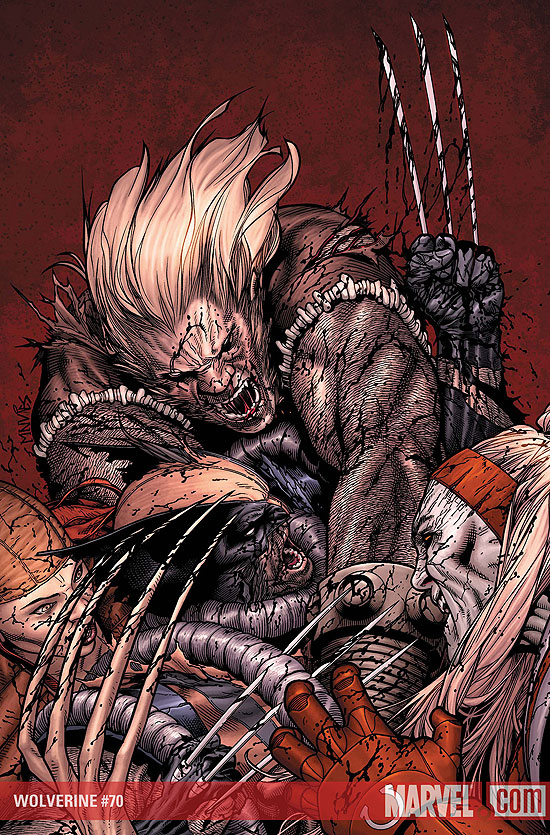
I just picked this comic up, written by Mark Miller art by Steve Mcniven. Nothing better (as far as comics go) than seeing what Wolverine could inflict with his claws. So this comic aint for the faint hearted. It’s gore intensive to a point. An odd story or take on the Wolverine character, reminds me of an old western story where the gunslinger has hung up his gun (after a terrible event forced him to give away violence), of course we know eventually he comes around and blows the bad guys into oblivion.
Miller is a good writer and the artist Mcniven backs it up, with clean lines and a fluid story board.
The story, well 50 years ago Wolverine killed the X-Men by error. It’s alternative future, a decimated America with Wolverine and a blind Hawkseye wandering through the American wasteland.
An interesting ride, check it out.
Posted in Books, Comic Reviews | Tagged: blood, gore, Mark Miller, Marvel comics, old man logan, STEVE MCNIVEN, Wolverine | 2 Comments »
The Punisher – Living in Darkness Part 1 (Marvel Comics). Writer: Rick Remender, Art: Jerome Opeña
Posted by Adrian on January 14, 2009

Again another fine release from Marvel, what’s going on? A lot of these new releases fall under the ‘Dark Regin’ sub heading. So what have we got here that differentiates Garth Ennis Punisher and Matt Faction’s Punisher? Possible a literary experiment from Marvel, tying in the three Punisher releases in time for the movie Punisher War Zone opening. I would be dubious if the quality wasn’t there for all three releases, but with Ennis powering out another memorable Punisher run and Faction hanging in there; another writer (Rick Remender) has taken on the Punisher script and dropped a bomb. Damn this is a fine start, nothing better than seeing a ‘black and white’ character such as the Punisher survive the complexity of the everyday world, complexity in the sense that The Punisher tries to deal with a situation, namely Norman Osbourne’s power grab after the Skrull invasion. Sort of a long story, but if just picked up this comic, Osbourne is a bad guy.
Add one Punisher who is trying to assassinate him, great opening sequence courtesy of art by Jerome Opena. Of course this plan to blow Osbourne’s head off is thwart by the Sentry, Marvels equivalent to DC’s Superman. So a straight kill of a bad guy (Norman Osbourne) kinda goes south for the Punisher, as a mere mortal with guns (Punisher) barely gets out in one piece after going toe to toe with the indestructible Sentry.
This Punisher (Remender) version could turn out to be a more gritter version of Factions’ Punisher War Journal.
Punisher – ‘Living in Darkness’ is off to a great start.
Posted in Books, Comic Reviews | Tagged: Jerome Opena, marvel, Rick Remender, Sentry, The Punisher - Living in Darkness | 1 Comment »
Deadpool (Marvel comics) Writer: Daniel Way, Art: Paco Medina
Posted by Adrian on January 13, 2009

Marvel comics are putting out some solid books at the moment and Deadpool is one of those releases. Written by Daniel Way with his trade mark sardonic wit, with good clean art by Paco Medina. It’s the ‘mercenary with a mouth’, a wise cracking good guy. Funny, bizarre and action packed.
Good fun.
Posted in Books, Comic Reviews | Tagged: Deadpool, Marvel comics | Leave a Comment »
The Punisher is back! Or rather the writer Garth Ennis (Marvel Comics)
Posted by Adrian on December 22, 2008

After the incredibly well put together MAX run of Garth Ennis’s Punisher concluded, it was unsure if Ennis would return with another run. Obviously Ennis’s Punisher MAX run had finished on Marvel, replaced by writer Gregg Hurwitz and art by Laurence Campbell. Personally I am not into the new MAX Punisher run and the Matt Fraction’s Punisher War Journal has kinda died on the vine, also I am not a huge fan of Howard Chaykin’s art. So that leaves the Marvel Knights Punisher War Zone and because Ennis is an adaptive writer, this Punisher story doesn’t have the raw grittiness that the MAX series had, but rather a sardonic style, similar to the Barracuda run. Art by Steve Dillon, gives that caricature feel, especially the mobster characters. It’s going to be a short run lasting 6 issues, but it will be a fun worthwhile ride.
The gist. Well a bumbling ‘wise guy’ (funny intro in issue #1), saved by the Punisher (bumbling ‘wise guy’ was about to get whacked by another gangster) is used to discover the truth about merging and emerging east coast mafia families. Mafioso style schlock characters including the seemingly indestructible (head of the Gnucci family) quad amputee Ma Gnucci and a host of other characters thrown into the mix; and yes just for good measure the psychotic rich white guy who wants to kill the Punisher for killing his upper crust vigilante dad (Elite) – who indiscriminately murders the ‘lower class’.
Also other aspect of the story is Garth Ennis’s trademark strong female characters that often appear in his Punisher stories; in this run it’s the female police officer on the Punisher’s trail
Go check it out, another classic Ennis Punisher here.
Still Marvel has got 3 punisher series all running at once, Ennis’s Punisher War Zone, Punisher War Journal and MAX Punisher. A forth is also on the way which is a new Punisher run, yes this run has that dreadful t-rating Marvel marketing ploy. But all and all this is to get the market ready for the Punisher movie “War Zone” that will be released in 2009.
So it’s all sales pitches, but in a recessionary market environment, be choosy. I am.
Posted in Books, Comic Reviews | Tagged: ennis, marvel, punisher | Leave a Comment »
Secret Six #1. Written by Gail Simone; Art by Nicola Scott and Doug Hazlewood; Cover by Cliff Chiang.
Posted by Adrian on October 17, 2008

I like Gail Simone’s writing. It’s cynical, offbeat and doesn’t follow the straight line, or formula. Well there is style and I guess you could say formula in her writing. But her style which is a far cry from black and white scenarios, she merges a lot more chaos, unpredictability and individuality in her stories. Unique character traits because her characters do not follow the standard structures. She writes about the anti-hero, or the reality that no one is that good all the time (as far as comic heroes go). The Secret Six fits into this unique paradigm. Each character has issues, but they seem relatively stable and honest in their view of the world. I mean to a point where you can relate and identify with the characters, or maybe it’s the realization that since we all have gone through a time of governmental, society even scientific assumptions that theorized, ‘yes we know how humans think and act now’ or ‘we broke that mysteries human code’ and finally ‘yes they are predictable’. Hence our horrible leaders like that dreadful English Prime Minister Tony Blair (famous quote “Why, thanks to economic growth, billions of pounds of wealth has been created, not lost in … boom and bust” – 1999 speach) and his hopeless predecessor (that fool Gordon Brown – UK), not to forget the political joke (and a bad one) of the 21st century George Bush and also not to forget the slew of other ‘leaders; that made statements and policy pertaining that society and culture is a one track ‘stable’ mind (the joke is on them of course – re: economic chaos and turmoil). Remember George Bush’s ridicules verbal vomit when he said, ‘if you are either with us or against us’. The premise being ‘us’ a homogeneous mass of ‘yes men’ and ‘yes women’ (a society of dumbed down gullible fools, ok may that was true to a degree – but we are all snapping out of that now, right?).
My point is when you read Simone’s comics, particularly her Secret Six series, she kinda tears that one track homogeneous thought patten into a billion pieces, reaches the expectation that chaos and mayhem is the basis around culture and society. Which is basically the human condition (culture), of course at the end of the day, that chaos, that uniqueness and unfortunately at times mayhem and violence. Gives rise to progression that then fights against oppression and tyranny. Yeah philosophical, but what the fuck.
So, the Secret Six are heroes, they know what is right and wrong and that blurring line between, but it’s done with the expectation that at the end of the day, ‘what’s in it for me’ and ‘no I don’t work for you’ or believe in your moral crusade. Which is to serve your self interest and I end up getting shafted in the end. It’s the highest bidder that gets their attention, but the way the Secret Six are as characters, someone is always trying to double cross them.
Anyway, it’s a great comic, well written, clean art. Very much worth checking out. Recommended.
Check here for my older reviews.
Posted in Books, Comic Reviews | Tagged: DC comics, gail simone, secret six | Leave a Comment »
Reviews October 2008: DAREDEVIL #111 (Ed Brubaker, Clay Mann, Stefano Gaudiano & Matt Hollingsworth)
Posted by Adrian on October 6, 2008

What a surprise this comic was. After years of depressing a great character down that being Matt Murdock/Daredevil by Brian Bendis. No offense to him, but desperately trying to humanize the Daredevil character ala what Frank Miller did with the Daredevil character 25 years ago (successfully). Bendis simply created an over serious character, that essentially stripped down any readers interest to nothing. It was a boring run. The new writer Ed Brubaker was left with that stilted boring approach (somewhat immulating Bendis’s style) and now it appears he is trying to throw it, can he do it? Well with DD # 111, he tries and succeeds. Away from that rigid, photographic style of art courtesy of Alex Maleev and Michael Lark, the new artist (Clay Mann) brings in some of that fantasy superhero style that we want to see (with doses of realism). A new additional character called Lady Bullseye. Yes a female reincarnation (not literally) of one of the greatest, psychopathic killers ever devised in comics – Bullseye.
So we have a return to the fun, violence, sex and interest (not to leave out the stern seriousness of Matt Murdock) to the Daredevil run. Miller may have instigated that fine balance of those three character developments (fun, violence and sex) to the DD character. The trick is can a writer expand and keep the flow? Not relying too much on the ‘ stern seriousness’ of Matt Murdock. We shall see.
Posted in Books, Comic Reviews | Tagged: Daredevill, Lady Bullseye | Leave a Comment »
Wildcats #1 Worlds End Christos Gage; Art by Neil Googe and Trevor Hairsine;
Posted by Adrian on August 19, 2008

Wildcats – Worlds End #1 Written by Christos Gage; Art by Neil Googe and Trevor Hairsine
Another solid release from Wildstorm, the World’s End story arc from both the Authority and Wildcats is showing a lot of promise as an interesting development in the Wildstorm universe.
Although I still think that Captain Atom: Armageddon written by Will Pfeifer has been hard to top, he was able to bring a inter-dimensional 4-way, with Captain Atom from the DC universe, Wildcats, The Authority and Majestic. The ‘stranger in the strange place’ story (Captain Atom, y’know from the Batman and Superman universe) mixing up with a crazy Wildstorm universe. With the human race as a kinda helpless bystander, as the 4-way meet up raise hell on each other, with the backdrop being various US cities getting hammered. It was a great read with a cataclysmic changing event at the end. But that is where it ended, typical Wildstorm fashion it ‘died on the vine’ and the story just disappeared. Although there is a kinda dedux (although unrelated to the Captain Atom: Armageddon run) with the DC crossover DreamWar which I haven’t read.
Can World’s End finally get Wildstorm up and going and at least maintain the story arc and leave a nice lasting impression? Remains to be seen. Wildstorm comics has, to say the least, some of the best characters ever created for comics. At times handled extremely well by various writers. The Midnighter run was almost perfect, thanks to writer Keith Giffen; an open alpha and omega story (if that makes sense?), which is good especially with a character like the Midnighter. Very well crafted series by the writer (and writers – Garth Ennis and others) who even managed to extend it from that ‘safe’ 1-6 comic run most companies experiment with these days (Midnighter lasted 20 issues!). Not to forget Chuck Dixon’s The Midnighter/Grifter team up which again was excellent. So there are nice moments with the essential Wildstorm characters. With the Grifter being one of the coolest Wildstorm characters, a good adult character, I would love to see a stand alone comic with him. A ultra violent, sex ridden comic. I am not on the Wildstorm’s payroll, but a good suggestion is for Wildstorm to develop a Marvel style MAX comics style spin off (Wildstorm style); starting with a Grifter run, hey?
But Still Christos Gage, a talented writer has got the reins on the Wildcats World’s End story and it has done a great job with issue 1, clean and nice detailed art by Neil Googe and Trevor Hairsine. Despite my idea of a Max style comic series on Wildstorm, Wildcats World’s End has got that nice flow of violence and adult sexual innuendos (minus any high school drivel). So with the Authority stranded on a destroyed London, trying to help the little survivors out there, The Wildcats based in LA are trying to protect the decimated LA populous (what’s left) from gangs of post- humans (eating survivors). Whilst the Authority is holed up in the damaged carrier, the Wildcats are living in the Halo building (their base) and bringing survivors back for food and medical attention. Then the loony Majestic shows up.
So far so good for the Wildstorm World’s End with Wildcats #1 off to a stella start.
Posted in Books, Comic Reviews | Tagged: Gage, grifter, wildcats world's end, Wildstorm comics | Leave a Comment »
 morbius glass
